
Saturday, September 5, 2015


Tuesday, February 17, 2015
The Kerygma by Kiko Arguello

"The Way's founder, Kiko Arguello, has written a book that is dramatic, intense, and deeply personal"
Source: Catholic Herald
I have just finished reading The Kerygma, by Kiko Arguello, published by Ignatius and distributed in the UK by Gracewing. For those who haven’t heard of this author, he is the founder, along with Carmel Hernandez, of the Neocatechumenal Way, one of the largest of the new movements in the Church. I am very glad I have read Kiko’s book as it has cleared up some misconceptions I had about the Way, as it is often referred to: that it operates within the Church like a cult and is divisive within the parish setting. Rather, what the Way offers is a wholehearted commitment to the Gospels. Indeed, the word “Kerygma”, chosen as the title of the book, means to announce the Good News of Christ – in a manner that keeps it permanently alive in the lives and hearts of its members.
Kiko Arguello was a young, successful Spanish artist in Spain in the early 1960s who had lapsed from his childhood faith but who was desperate to find a spiritual meaning to life. He writes, “I couldn’t be indifferent as to whether God exists or not, it was a matter of life and death.” He briefly flirted with Marxism; disillusioned by its lack of a spiritual vision he did what traditionally the saints have often done: he decided to live in a notorious shantytown, a “descent into hell”, where he daily experienced the seemingly intractable problems of the poor: violence, alcoholism, disease and despair. He took with him his guitar and a Bible and slept on a mattress on the dirt floor of a shack. The question that consumed him was: how did the early apostles spread the Gospels? How could he preach effectively to people living in such degradation?
A meeting with Carmen, a lay missionary who was also drawn to living among the poor led to the founding of the Way. They based it on three things: the word of God, the Eucharist and the Christian community. They both felt that the usual parish structure that had developed over centuries was not adequate as a “school for Christians” – especially the outcasts, gypsies, tramps and slum dwellers who did not fit into normal society.
They realised you cannot evangelise others without personal conversion. This required proper formation in the faith as well as ongoing catechesis, regular prayer, study and Bible reading. The idea of the “Christian community” was born. Its purpose: the evangelisation of those far from the Church, modern secular men and women whom the parish structure could not reach. Members of the Way recognise the need to form Christian communities of love, for it is only through love that others will be drawn to the listen to the “Kerygma” and be transformed by it.
Kiko’s book is not a detailed, chronological history of this new movement; he doesn’t include a description of its development around the world or its numbers, though he does mention casually that 300,000 young members attended the World Youth Day in Madrid and that the Way is – amazingly – preparing to send thousands of priests to China. His writing is dramatic, intense, deeply personal and poured out from the heart; the story of how one man allowed the Holy Spirit to work within him and thus do extraordinary things. I do recommend it.
One of the key aspects of the Way is members’ sense of mission. Being a Christian, they believe, is never a matter of private, weekly devotion; it is always outgoing, evangelical and bound up with renewal and conversion. Only at the end of the book did I get a glimpse of the problems such a vivid and total form of Christian discipleship might pose in your average parish. Kiko comments, that “We have been persecuted and expelled from many parishes. Sometimes the Way is misunderstood and confused with a sect”. He doesn’t explain this further.
Having read the book I was curious to find out from an actual member of the Neocatchumenal Way how it impacts on one’s life. Elizabeth Flynn is a longstanding member of a London community. She tells me that as a young adult Catholic she spent some years among Evangelicals, drawn to their warmth and fellowship. She was attracted to their uninhibited way of talking about a personal relationship with Jesus and their enthusiasm for conversion. But she knew they lacked authority and eventually she joined Crux, a small Catholic study-group. But it still “wasn’t quite what I was looking for”. Finally she went along to a community of the Way that was meeting in the parish of St Charles Borromeo. “From the very first evening I knew I was in the right place” she tells me. That was in 1993.
At every session she attended she heard something new “that drew me further on.” She emphasises that they are clear about Church authority and completely obedient to the Church’s magisterial teaching. “The way they preach makes the Bible come alive” she feels, and that she has come to a much closer knowledge and love of God through the Scriptures, as a result of membership.
Elizabeth believes that joining the Neocatechumenal Way has changed her life in every way. “Life is full and rich and even suffering makes sense” she says. She also has “a much deeper relationship with God than I could ever have imagined possible.” She adds that she is much more confident about “putting my head above the parapet and letting people know I’m a Christian.” She thinks the kind of Christian formation and support she receives simply isn’t available in the wider parish. She tells me the Way is also largely successful in keeping teenagers and young people within the Faith. It encourages large families because “the teaching is uncompromisingly open to life.” There are many vocations and thus a hugely expanding number of seminaries worldwide.
I ask her the question about what seems to be the source of much discontent: why do they celebrate their own liturgy? Elizabeth says that they participate in the parish liturgy but also have their own mid-week liturgy, so that members of the community who have undergone catechesis together can deepen their bonds with each other in their continuing journey of faith. It gives them “the opportunity to share, after the Bible readings, what God is saying to them through his Word. This needs to be done within the enclosed group so that privacy can be maintained.”
She is clear that they do not want to be a special group within the parish and that they try to blend in. She sums it up: “We’re Catholics living the faith, radically, in the parish.” It strikes me that this might be enough to make other parishioners, who are less zealous or committed, feel challenged and disturbed. But I also have the uncomfortable feeling that this is actually what God demands of all of us. After all, wasn’t Jesus radical? And aren’t his teachings still radical and uncompromising today – for those who have ears to hear?
She is clear that they do not want to be a special group within the parish and that they try to blend in. She sums it up: “We’re Catholics living the faith, radically, in the parish.” It strikes me that this might be enough to make other parishioners, who are less zealous or committed, feel challenged and disturbed. But I also have the uncomfortable feeling that this is actually what God demands of all of us. After all, wasn’t Jesus radical? And aren’t his teachings still radical and uncompromising today – for those who have ears to hear?
Tuesday, February 3, 2015
Monday, December 26, 2011
“O God, be merciful to me a sinner.”
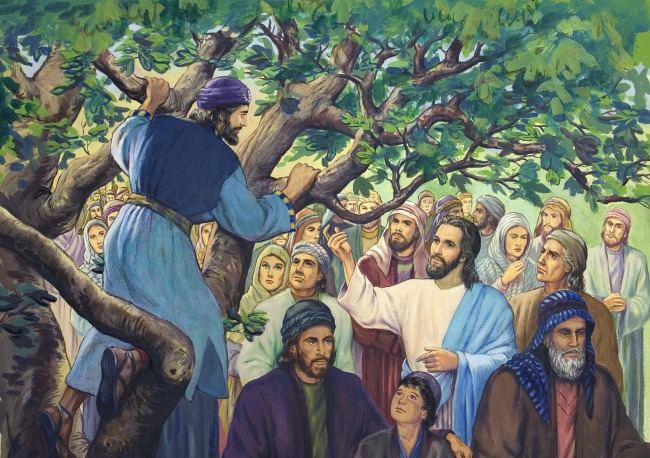
Chapter 19: 1-10 Zacchaeus
the Tax Collector
In the Gospel of Luke, Jesus uses many parables to
illustrate his Good news.
“The Parable of the Pharisee and the Tax Collector” in
Luke 18: 9-14 is my favorite where Jesus made comparison between the Pharisee
and the Tax Collector. The Pharisee was bragging or boasting about his righteousness…
thanking God that he was “not like the rest of the humanity – greedy,
dishonest, adulterous, even like this tax collector, fast twice a week, pay
tithes.“ While the tax collector stood off at a distance and would not raise
his eyes to heaven but beat his breast and prayed “O God, be merciful to me a
sinner.”
In the Gospel of Luke 18:18-25 A Rich Official
encountered Jesus and asked “What must I do to inherit eternal life?” After the
rich official told Jesus that he had kept his commandments since his youth, Jesus
said to this rich official, “There is still one thing left for you: sell
all that you have and distribute it to the poor, and you will have a treasure
in heaven. Then come a follow me.” But when he heard of this he became
quite sad, for he was very rich. Jesus looked at him and said, ”How
hard it is for those who have wealth to enter the kingdom of God!”
Climbing a
Sycamore tree – a humble act for the Chief Tax Collector
According to the Gospel of Luke, it was not long after
he told the above parable and encountered the Rich Official that Zacchaeus the
Chief Tax Collector of Jericho who was also a wealthy man encountered Jesus.
Zacchaeus probably has heard about Jesus and his teaching. He was seeking to
see who Jesus was but he was short so he climbed a sycamore tree in order to
see Jesus. At this juncture, I want you to try imagining that someone short,
very wealthy (humbling himself) by climbing a tree in order to meet Jesus. That
act of humbleness perhaps caught the eyes of Jesus. And, Jesus asked him to
come down quickly, for he must stay at his house.
Can you imagine what an honor it must have been for this
little man Zacchaeus, a chief Tax collector for Jesus to stay at his house? His is a kind of
smallness that is far more devastating than being short. His smallness emerges
from his terrible self-image resulting from others’ attitudes toward him. Though a member of a group that was widely despised,
Zacchaeus appears in today’s story as a fundamentally honest and humble man who
seeks the truth and is open to finding it where he can, even if it means
climbing a sycamore tree in a crowd, just to catch a glimpse of Jesus.
Give half of his possessions to the poor, those that
I have cheated, I shall repay it 4 times over – “Zacchaeus acknowledges that he
is a sinner needing the mercy of God”
Zacchaeus
provides a contrast to the rich man of Luke 18:18-23 who cannot detach himself
from his material possessions to become a follower of Jesus. Zacchaeus,
according to Luke, exemplifies the proper attitude toward wealth: He promises
to give half of his possessions to the poor, and consequently is the recipient
of salvation.
We have much to learn from Zacchaeus - His humility,
his recognition of his sin, his act of reparation.
“O God, be
merciful to me a sinner.”
Transformation
In
his Letter to Priests written for Holy Thursday 2002
(Nos. 5-6), the Servant of God Pope John Paul II wrote these words about
today’s delightful Gospel story:
Everything
that happens to him (Zacchaeus) is amazing. If there had not been, at a certain
point, the ‘surprise’ of Christ looking up at him, perhaps he would have
remained a silent spectator of the Lord moving through the streets of Jericho.
Jesus would have passed by, not into, his life. Zacchaeus had no idea that the
curiosity which had prompted him to do such an unusual thing was already the
fruit of a mercy which had preceded him, attracted him and was about to change
him in the depths of his heart. [...]
Luke’s
account is remarkable for the tone of the language: Everything is so personal,
so tactful, so affectionate! Not only is the text filled with humanity; it
suggests insistence, an urgency to which Jesus gives voice as the one offering
the definitive revelation of God’s mercy. He says: ‘I must stay at your house,’
or to translate even more literally: ‘I need to stay at your house’ (v 5).
Following the mysterious road map which the Father has laid out for him, Jesus
runs into Zacchaeus along the way. He pauses near him as if the meeting had
been planned from the beginning. Despite all the murmuring of human malice, the
home of this sinner is about to become a place of revelation, the scene of a
miracle of mercy. True, this will not happen if Zacchaeus does not free his
heart from the ligatures of egoism and from his unjust and fraudulent ways. But
mercy has already come to him as a gratuitous and overflowing gift. Mercy has preceded
him! [...]
This
is what happens in the case of Zacchaeus. Aware that he is now being treated as
a ‘son,’ he begins to think and act like a son, and this he shows in the way he
rediscovers his brothers and sisters. Beneath the loving gaze of Christ, the
heart of Zacchaeus warms to love of neighbor. From a feeling of isolation,
which had led him to enrich himself without caring about what others had to
suffer, he moves to an attitude of sharing. This is expressed in a genuine
‘division’ of his wealth: ‘half of my goods to the poor.’ The injustice done to
others by his fraudulent behavior is atoned for by a fourfold restitution: “If
I have defrauded any one of anything, I restore it fourfold” (v 8). And it is
only at this point that the love of God achieves its purpose, and salvation is
accomplished: ‘Today salvation has come to this house’ (v 9).
Sunday, October 23, 2011
Love from Christian Perspective
1) GospelMt 22:34-40

When the Pharisees heard that Jesus had silenced the Sadducees,
they gathered together, and one of them,
a scholar of the law tested him by asking,
"Teacher, which commandment in the law is the greatest?"
He said to him,
"You shall love the Lord, your God,
with all your heart,
with all your soul,
and with all your mind.
This is the greatest and the first commandment.
The second is like it:
You shall love your neighbor as yourself.
The whole law and the prophets depend on these two commandments."
they gathered together, and one of them,
a scholar of the law tested him by asking,
"Teacher, which commandment in the law is the greatest?"
He said to him,
"You shall love the Lord, your God,
with all your heart,
with all your soul,
and with all your mind.
This is the greatest and the first commandment.
The second is like it:
You shall love your neighbor as yourself.
The whole law and the prophets depend on these two commandments."
2) Jewish idea of Love
The
Jewish idea of responsibility when it comes to who is to be loved goes like
this. Everyone was to love God, that was compulsory. But everyone else was
graded as to how much love they were to be given. There were those people to
whom it was a responsibility to show love. Those on the outer circles of the
community, like outcasts, sinners, tax collectors, Gentiles, Samaritans etc,
some were to be loved less, or others were owed no love whatsoever. The
Pharisees had established many laws to help people in their observance of this
command. These laws told people whom they were to love, and whom they could
ignore.
By
saying that the greatest commandment is to love God and to love your neighbour,
this gives a new slant to the traditional interpretation. To love God that was
clear enough but to also say to love one another in the same breath puts both
of these commands on an equal footing.
The
love of God and the love of our neighbour are inseparable. You cannot claim to
love God if you don't love your neighbour. Essentially the entire law of God
can be boiled down to two simple commandments: Love God with your whole being;
and love whomever God puts next to you as you love yourself.
3)
What is LOVE?
Before
we go any further we need to understand what Jesus means here when he uses the
word love. That little four letter word "love" is used in many
contexts. We talk about loving our dog, loving strawberries and ice-cream, or
loving a member of the opposite gender. When we use the word love like that we
are expressing our affection and have warm feelings for whatever it is that we
are loving. Because we associate the word "love" with affection it’s
no wonder that we have difficulty loving those people who annoy us, those who
have hurt us, and those who don’t deserve to be loved.
When
the Bible talks about love it primarily means a love that keeps on loving, it
means commitment. We may have warm feelings of gratitude to God when we
consider all that he has done for us, but it is not warm feelings that Jesus is
demanding of us. It is stubborn, unwavering commitment. It follows then that to
love one another, including our enemies, doesn’t mean we must feel affection
for them, rather it means a commitment on our part to take their needs
seriously, just as God committed himself to taking our needs seriously by
sending his Son into this world. You see this in marriages where because of the
aging process one partner has become physically incapacitated, difficult to
live with, very demanding, and yet the other partner keeps on caring and
putting up with it all. That’s coming close to the biblical idea of love. It’s
that commitment even though it isn’t deserved. It’s that stubborn, unwavering
commitment to the other person’s needs often at a great sacrifice to
him/herself.
4) Example
of Love in action.
This
kind of love doesn’t come naturally. It is true that this kind of love comes
from God, but putting it into practice is something we have to work on. Love –
commitment - is a deliberate action of the will. To love means deliberately to
turn toward another person and their needs, to give away something of ourselves
to someone else without thinking of what we will get in return. In Luke’s
Gospel Jesus tells the parable of the Good Samaritan (Luke 15:25-37) we see an
example of a man loving his enemy, committing his money, time and energy to
seeing to the needs of the man lying in the gutter. He stopped to help and to
hang with the consequences. All he could see was someone in need. This kind of
love/commitment is self-sacrificing. It is putting the other person first,
whether it is God or our neighbour.
In
all honesty, it doesn’t take much imagination to realise that this kind of love
has been in short supply in our lives.
Because
this is not the case Jesus came to pay for our lovelessness. He showed us what
true love is. His love touched the dumb, the deaf, the diseased, the disabled.
His love warned, wept and washed dirty feet. His love told of a shepherd
searching for lost sheep, a Father rushing out to embrace and kiss his lost son
as he welcomed him home. His love turned the other cheek, and willingly walked
that extra mile. His love carried a cross -- and died upon it! His love
welcomed each of us into God's family, forgiving our sin in the water of our
Baptism.
Jesus
came to make us more loving. What form this loving takes is not important, but
what is important is that it does take place. When you fail, remember Jesus
loves you, and let his love shine through you into the lives of the people
around you.
Copyright
2005, Pastor Vince Gerhardy
Tuesday, October 18, 2011

Friday, September 16, 2011
Does God Harden the Human Heart?

The words of the Apostle, "So then he has mercy on whomever he chooses, and he hardens the
heart of whomever he chooses" (Rom 9: 18) are highly puzzling, even
scandalising, to some. In the circumstances, it is essential to know the
background of this utterance of St Paul in his letter to the Romans, in order
to resolve the doubt.
God chose Israel as his own people. But they
rejected Jesus. Hence it was God's will that salvation should be given to the
gentiles. God can, by his almighty power, bring anyone he likes to salvation
and can punish anyone he wishes to punish - this is the underlying principle in
St Paul's assertion in Romans (Rom 9:18), and it is in relation to this idea
that his above statement should be seen.
The
Background of the Old Testament
In order to proclaim God's name throughout the world
and to reveal his power he raised up Pharaoh (cf Ex 9:16; Rom 9:17). All the
same, Pharaoh became hard-hearted. This event in the book of Exodus is the
background of Rom 9:18. We read several times in Exodus that Pharaoh became
hard-hearted by refusing to grant freedom to the Israelites.
"Pharaoh's
heart is hardened; he refuses to let the people go" (Ex 7:14).
The same idea can be clearly seen again in Exodus 7:22; 8:15,19,32; 9:7. The truth is that by his own fault, Pharaoh
hardened his heart (cf Ex 5:2). It is also true that God gave him several
occasions to be converted. But Pharaoh failed to make use of those occasions
and that is why God made Pharaoh's heart hard (cf Ex 4:21; 7:3; 9:12; 10:1,20,27;
11:10). Pharaoh could have cooperated
with God as Cyrus the Persian king cooperated with divine inspiration and gave
freedom to the Israelite nation. But he did not do so. We read in the Old
Testament that God made the hearts of many other kings also hard (for example,
cf Dt 2:30; Jos 11 :20). At the same time we must not forget that it is God
himself who will "remove from...(our) body the heart of stone and
give...(us) a heart of flesh"(Ez 36:2).
Jesus spoke in parables in order that "they may
indeed look, but not perceive and may indeed listen, but not understand; so that
they may not turn again and be forgiven" (Mk4:12). This is indeed a
statement similar to that in Rom 9:18. Jesus is here quoting an Old Testament
prophecy. "Keep listening, but do not comprehend; keep looking, but do not
understand" (Is 6:9-10). Though the people listened to the parables
and teachings of Jesus, they hardened their hearts because of their own
stubbornness. This is the meaning of the statement in the original
Greek. The parallel statement in Matthew's gospel, "This is why I speak to
them in parables, because seeing they do not see and hearing they do not hear,
nor do they understand" (Mt 13: 13 RSV) is more explicit and clarifies the
idea further.
The
Thinking of the Ancients
We need to see the viewpoint of the ancients in the
statement “God hardened his heart.” The ancients did not clearly distinguish between
the divine power and human freedom behind any action. They did not either do
any philosophical analysis of the relationship between the two. Their guiding
principle was to depend on God and go forward.
"But who indeed are you, a human being, to
argue with God? Will what is moulded say to the one who moulds it 'why have you
made me like this?'" (Rom 9:20). Such trends of thought of St Paul are
worth remembering in this context. The ancient people saw God as the final
cause of all events. Man cannot of himself complete his sojourn in this world. The
ancients firmly believed that God is the controlling power and Lord of all
history. The truth is that even the sinful acts committed by man misusing his
freedom were ascribed to God by Israel !
But
we know that God does not make man commit sin. Neither does it mean that God beforehand
decides and hardens man's heart. Man
rejects God's love and call. God observes this and shows his displeasure
towards man. In order to make this clear the Bible says "God hardened
man's heart.” This does not conform to modern man's reasoning and thinking -
that is all. God is also all merciful. To realise that God shows mercy to man
is not difficult for us. That God who loves will also punish is a truth that stands
revealed in the statement "God hardens man's heart”. Salvation and
punishment go together. It is difficult at times to grasp this truth.
Man’s
Freedom and Hard-heartedness
The
history of man's first sin proves that though God's omnipotence is working in the
universe and in individuals, man has the freedom to choose evil.
Flavius Josephus, the Jewish historian, who lived in the beginning of the first
century (A. D), had grasped this truth very well, It is the freedom to love God or
to reject his commandments that makes man, man. A mechanical love and service
of God have no validity. True holiness is to fight the battles of life,
win the victory and be sanctified.
God
does not make man fall into sin. The word of God testifies that there is no
evil in him(cf Ps 5:4; Hab 1 :13). St James says this very explicitly: "No
one, when tempted should say, ‘I am being tempted by God'; for God cannot be tempted by evil and he
himself tempts no one" (1 :13).
All men are beggars before God. Those who prayerfully
stretch out their hands before God, the
King of kings, will receive blessings and graces from him. It is no use being
surprised at those who, because of their own fault fail to do so and consequently
do not receive his mercy. Even today, of the people attending a convention,
some achieve conversion of heart while others return with hardness of heart. At
the last judgement there will be sheep and goats. In short, God’s absolute power and man's freedom are two sides of the same
coin. One is at liberty to choose life or death (cf Dt 30:19).
Concluding
Thoughts
It is true that God chooses some and punishes
others. It was not the elder son Esau that he chose but the younger one, Jacob.
In the sight of God no one has the right to demand justice or claim salvation.
St Paul says very clearly that everything is God's gift and mercy. He has the
freedom to distribute his gifts to those whom he likes. Man, however, has to do
the works of justice, believe in Jesus Christ, the Apostle continues to
explain. St James too highlights the necessity to do works of faith.
It is a fact that even today there are numerous
people who refuse to listen to the word of God, and like Pharaoh and the Israelite
nation, harden their hearts. "Today if you hear his voice, do not
harden your hearts as in the rebellion"(Heb 3: 15). Let us listen
to the prophetic voice telling us to remove from our body the heart of stone
and replace it with a heart of flesh (cf Ez 36:26). If this heart
transplantation must take place in us we must have a heart on which the law is
written by the Holy Spirit (cf Jer 31 :33).
Source:
Questions PEOPLE Ask on the Bible by Dr. Paul Kariamadam
Subscribe to:
Posts (Atom)